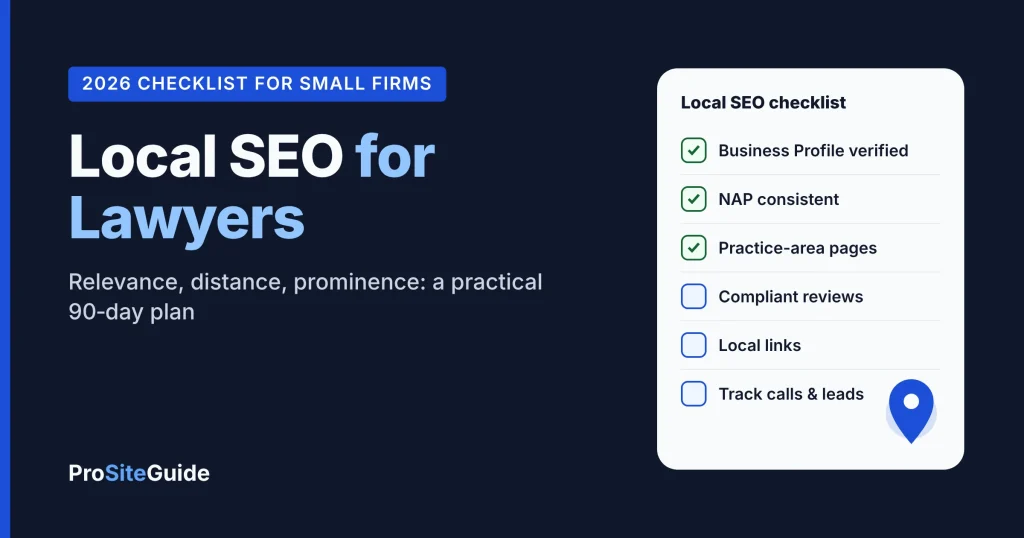
Quick answer: Local SEO for lawyers means making your firm the most relevant, credible and easy-to-verify option when someone near your office searches for a lawyer. Google says local results are based mainly on three things: relevance, distance and prominence. You can’t pay for a better local ranking, so the work is a verified and accurate Business Profile, a website with real practice-area and location pages, consistent listings, policy-compliant reviews, local links, and tracking the results.
This is the pillar checklist for small firms (solo to about 10 lawyers). It puts every local SEO task in order and links to our deeper guides where one exists, so you can work through it in 90 days without buying anything you don’t need.
Key takeaways
- Three factors decide local results: relevance, distance and prominence. Distance is mostly out of your control. The other two are not.
- The basics come first: a verified Google Business Profile, matching name, address and phone (NAP) everywhere, and one strong page per practice area.
- Location pages are fine; doorway pages are spam. Google’s spam policies name city pages that funnel visitors to one page as doorway abuse.
- Reviews must follow Google’s policy and your bar’s rules: no incentives, no asking only happy clients, and no confidential details in replies.
- Measure calls and forms, not just rankings. Use the Business Profile performance report and Google Search Console.
What is local SEO for lawyers?
Local SEO (search engine optimization) for lawyers is the work of showing up when people search for legal help in a specific place. That includes searches like “divorce lawyer near me” or “DUI attorney Tacoma”, and searches where Google guesses the person wants someone nearby.
For these searches, Google usually shows two kinds of results:
- The local pack and Google Maps: a map with a short list of Business Profiles. Rankings here come from your Google Business Profile for your law firm, plus signals from around the web.
- Regular (“organic”) results: web pages, including your practice-area pages, directory listings and articles. Rankings here depend mostly on your website.
Paid placements, such as Google Ads and Local Services Ads, can also appear at the top. They are advertising, not local SEO, so this checklist leaves them out. Good local SEO helps both the map and the organic results, because Google uses your website and the rest of the web to judge your Business Profile.
How does Google rank law firms in local results?
Google’s own help page, Tips to improve your local ranking on Google, says local results are based mainly on relevance, distance and prominence. It also says plainly: “There’s no way to request or pay for a better local ranking on Google.” Treat any vendor promising a guaranteed spot in the map pack with suspicion.
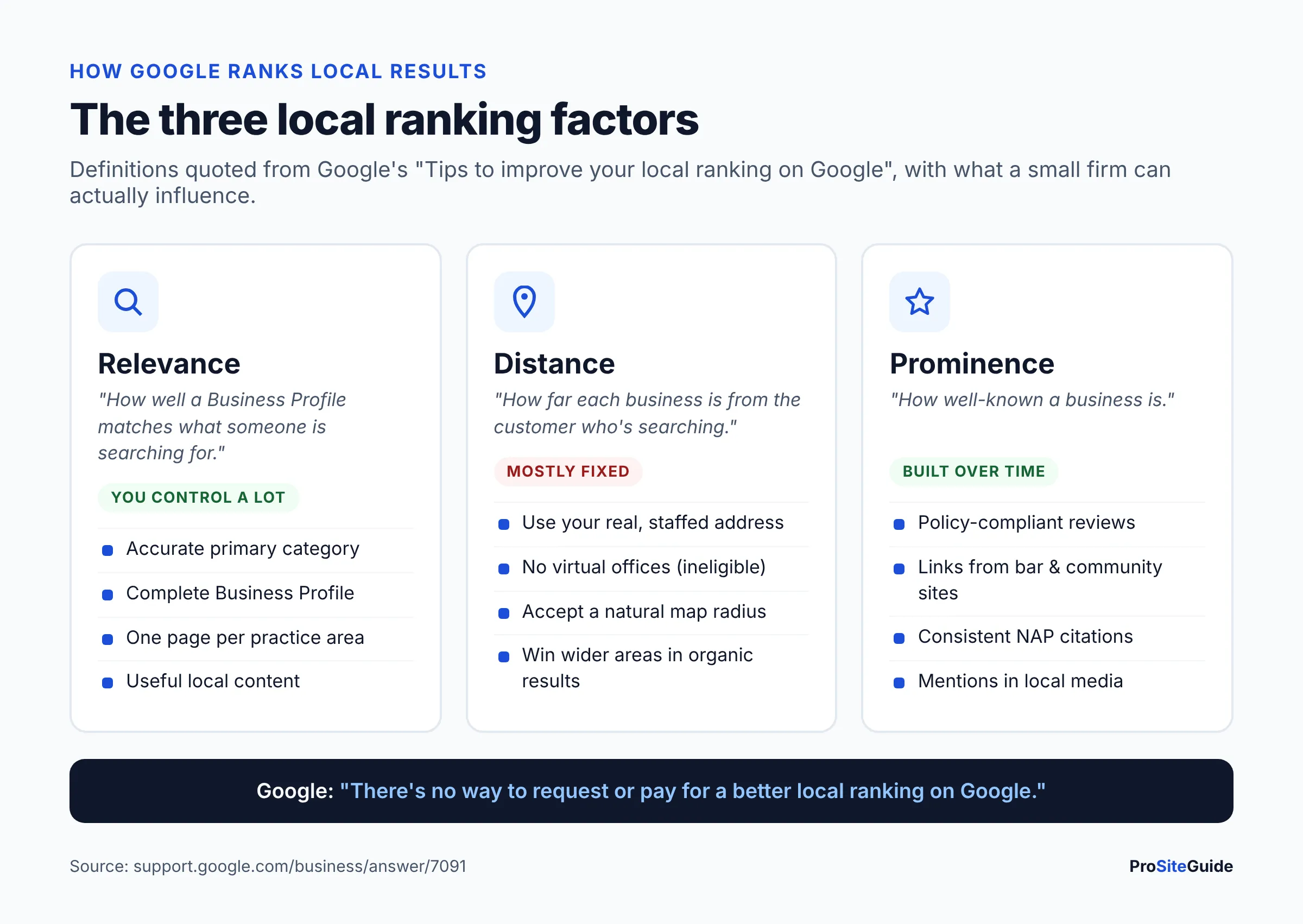
| Factor | Google’s definition | What a small firm can do |
|---|---|---|
| Relevance | “How well a Business Profile matches what someone is searching for.” | Accurate primary category, complete profile, a dedicated website page for each practice area. |
| Distance | “How far each business is from the customer who’s searching.” | Little. Use your real, staffed office address. Don’t invent offices to get closer to searchers. |
| Prominence | “How well-known a business is.” | Earn reviews, links and mentions; keep listings consistent; publish useful content. Google says more reviews and positive ratings can help, and that prominence also reflects how many websites link to you. |
What this means in practice: you can’t rank in the map pack across a whole metro area just by trying harder, because distance limits how far your profile reaches. You can make sure that, within your natural radius, Google has every reason to trust and show your firm.
Step 1: Get your Google Business Profile right
Your Business Profile is the single most important local asset. We cover setup, verification, categories, firm vs. lawyer profiles and suspensions in our full Google Business Profile guide for law firms, so here are only the rules that most often break local rankings, from Google’s guidelines for representing your business:
- Use your real-world name. Google says your name “should reflect your business’s real-world name”, and adding unnecessary information to it isn’t permitted. “Smith Law” is fine; “Smith Law | Best Car Accident Lawyer Dallas” is not.
- Use a real, staffed address. Google states that a mailing address where you don’t operate, “also known as a virtual office”, isn’t eligible. P.O. boxes are not acceptable.
- Use a phone number you control that connects to that specific office.
- Follow the practitioner rules. Lawyers count as individual practitioners. Support staff should not create their own profiles.
Step 2: Build website foundations that support local rankings
Your website is where Google checks whether your profile is relevant and credible. Most small-firm sites lose local visibility because of a few basic gaps, not because of anything advanced.
One strong page per practice area
If you handle DUI, expungement and domestic violence cases, each needs its own page. A single “Criminal Defense” page listing all three gives Google little to match against specific searches. Our guide to writing practice area pages covers structure, depth and ethics wording, so this article won’t repeat it.
Local signals on every key page
- Your full firm name, address and phone in the footer, written exactly as they appear on your Business Profile.
- A contact page with an embedded map, directions, parking notes and office hours.
- Page titles that name the service and the place naturally, for example “DUI Defense Lawyer in Tacoma, WA | Smith Law”. Google’s SEO Starter Guide says a good title is “unique to the page, clear and concise, and accurately describes the contents of the page.”
- Attorney bio pages that show bar admissions, court experience and local ties. See our guide to writing an attorney bio page.
Location pages vs. doorway pages: where is the line?
A location page is a page about a real office you staff. A doorway page is a page made only to rank for a place-name search, with little that helps the reader. Google’s spam policies define doorway abuse as pages “created to rank for specific, similar search queries”, and give this example: “Having multiple domain names or pages targeted at specific regions or cities that funnel users to one page.”
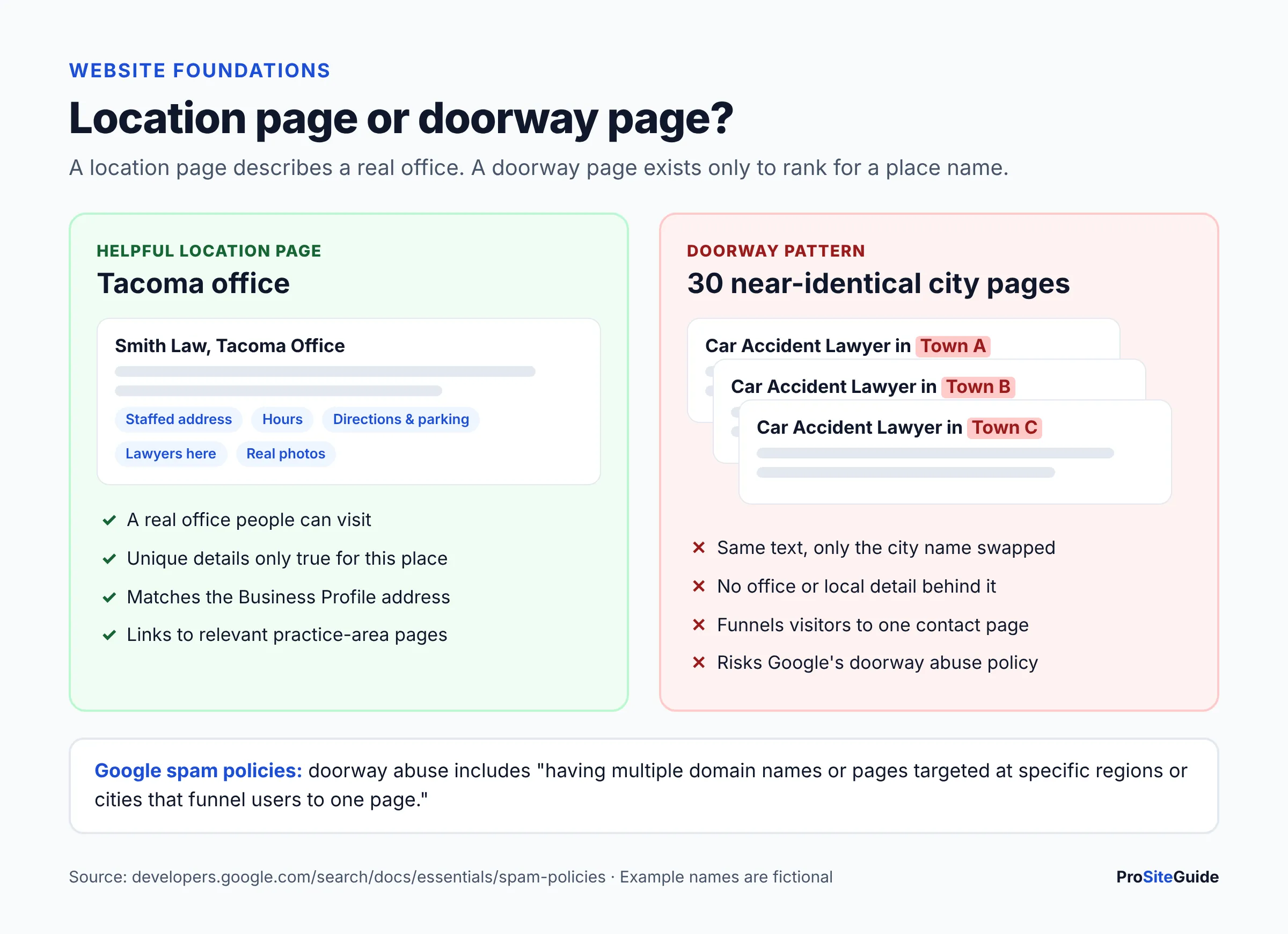
The classic law-firm mistake is 30 pages titled “Car Accident Lawyer in [Town]” with the same text and a swapped city name. Google’s spam policies also name “creating substantially similar pages” as doorway abuse. Use this test instead:
- Do you have a staffed office there? Build a real location page: address, hours, directions, the lawyers who work there, photos of the actual office, and the cases handled from it.
- No office, but you genuinely serve the area? Only create a page if you can say something specific and true: the local courthouse and how its process works, local procedures, or what clients there should expect. Otherwise, list the areas you serve on your main practice pages.
- Is the only difference the city name? Don’t publish it. Merge it into one strong page.
Structured data (schema)
Structured data is code that labels your firm’s name, address, phone and hours so search engines can read them reliably. Google’s LocalBusiness structured data documentation lists name and address as required properties, and says Google “does not guarantee that features that consume structured data will show up in search results.” It is a clarity signal, not a ranking switch. Our guide to schema markup for law firms has the details and examples.
Step 3: Make your NAP consistent and build citations
NAP stands for name, address and phone number. A citation is any mention of those details on another website, such as a directory listing. When your details match everywhere, Google and potential clients can be more confident that your firm is real and at the address you claim.
Do this in order:
- Pick one exact format for the firm name, address (including suite number style) and main phone number, and write it down.
- Fix the sources you control: website footer and contact page, Google Business Profile, social profiles and email signatures.
- Claim the other major map platforms. Microsoft describes Bing Places for Business as a free platform for listings that appear in Bing search and Bing Maps, and says it improved importing listings from Google. Apple lets businesses claim their location and control how it appears in Apple Maps through Apple Business.
- Update your state bar’s lawyer directory record. Most bars have a public member lookup. Make sure your firm address and phone there are current, following your bar’s own process.
- Add or claim legal directory profiles. Choose the well-known national legal directories and any reputable local ones that people in your area actually use. Free profiles are usually enough to start. Judge paid upgrades on whether they send calls you can track, not on promises of SEO value.
- Clean up old addresses and duplicates after any office move, merger or name change. Old listings with the wrong phone number cost you clients directly.
You don’t need hundreds of citations. A smaller set of accurate, relevant listings beats a mass submission to low-quality directories.
Step 4: Earn reviews the policy-compliant way
Google confirms that “more reviews and positive ratings can help your business’s local ranking.” For law firms, reviews also have to satisfy two rulebooks at once: Google’s review policy and your state’s professional conduct rules.
Google’s Maps user-generated content policy does not allow businesses to:
- “Offer incentives – such as payment, discounts, free goods and/or services – in exchange for posting any review.”
- “Selectively solicit positive reviews from customers.” That rules out “review gating”, where you only send the review link to clients who said they were happy.
- “Discourage or prohibit negative reviews.”
- Post reviews based on a conflict of interest, such as current or former employment. Staff and family should not review the firm.
On the ethics side, the ABA Model Rules (which most states follow closely) restrict giving anything of value for recommending a lawyer’s services. Minnesota’s version of Rule 7.2(b), for example, says a lawyer “shall not compensate, give, or promise anything of value to a person for recommending the lawyer’s services”, with narrow exceptions. Many states also have rules on testimonials and client confidentiality. Check your own state bar’s rules and ethics opinions before you start a review program.
A simple, compliant process:
- At the natural end of a matter, ask every client the same way, whatever you think they’ll say.
- Send a short email or text with your direct Google review link. No gift, discount or fee reduction attached.
- Reply to reviews without confirming that the reviewer was a client or revealing any details of the matter. Our Business Profile guide covers safe reply wording for negative reviews.
- Flag reviews that break Google’s policy through the profile; don’t argue publicly.
Step 5: Earn local links from real relationships
Links from other websites are part of prominence; Google’s local ranking page mentions “how many websites link to your business.” For a local firm, the most natural links come from things lawyers already do:
- Bar associations: state, county and specialty bar member pages, section pages, and speaker bios for CLE (continuing legal education) talks.
- Community involvement: nonprofit boards, pro bono partners, local scholarships you actually fund, youth sports or community events you sponsor.
- Local business groups: chamber of commerce member directories and business association pages.
- Education and media: law school alumni or adjunct pages, local news quotes, and guest articles for local publications.
- Professional referral partners: accountants, financial planners or therapists who list you as a resource, where that’s honest and allowed by your bar.
Avoid paid link schemes. Google’s spam policies list “buying or selling links for ranking purposes” as link spam, including “exchanging goods or services for links.” A paid sponsorship is fine as a sponsorship, but don’t pay specifically for a link to boost rankings.
Step 6: Publish content local clients actually need
Useful local content helps relevance and gives other sites a reason to link to you. Good examples for a small firm:
- “What to expect at your first hearing at [County] District Court”: parking, security, courtroom etiquette, typical timeline.
- How a local process works, such as protective orders, small claims limits or probate filing steps in your county, linked to the official court page.
- Answers to the questions your intake staff hear every week, written in plain English.
Skip generic posts that could be about any state. Google’s spam policies also warn against “scaled content abuse”: generating many pages mainly to manipulate rankings without adding value, whether a person or AI writes them. Five genuinely useful local pages beat 50 thin ones.
Step 7: Cover the technical basics
Technical SEO for a small law firm is mostly hygiene. Make sure that:
- The site loads quickly and works well on phones, where many local searches happen. See our guide to law firm website speed and Core Web Vitals.
- The phone number is a tap-to-call link and the contact form works (test it monthly).
- The site uses HTTPS and has an XML sitemap submitted in Google Search Console.
- Important pages aren’t blocked from indexing and each has a unique title.
- Hosting is reliable. A site that’s often down or slow undercuts everything else; our best hosting for law firm websites comparison covers options.
How do you measure law firm local SEO?
Measure leads first and rankings second. Two free Google tools cover most of what a small firm needs.
- Business Profile performance: Google’s performance help page lists calls from the call button, direction requests, website clicks, the search terms people used to find you, profile views on Search and Maps, and bookings (if you use a booking provider). Search terms update at the start of each month.
- Google Search Console: the Performance report shows clicks, impressions, click-through rate and average position, and can be grouped by query, page, country and device. Filter for your practice-area pages to see which local searches find them.
Add UTM tags to your Business Profile website link so that visits from it show up separately in Google Analytics. Our GA4 and Search Console setup guide for law firms walks through setup and conversion tracking. Then, once a month, compare three numbers: profile calls, website form submissions, and new consultations booked. Keep in mind that map rankings vary with where the searcher is standing, so a single “rank check” from your office isn’t the full picture.
A 30/60/90-day local SEO plan for a small firm
Google’s SEO Starter Guide notes that “every change you make will take some time to be reflected on Google’s end.” Plan in quarters, not days. This plan assumes a few hours a week from a lawyer or office manager, or help from your web developer.
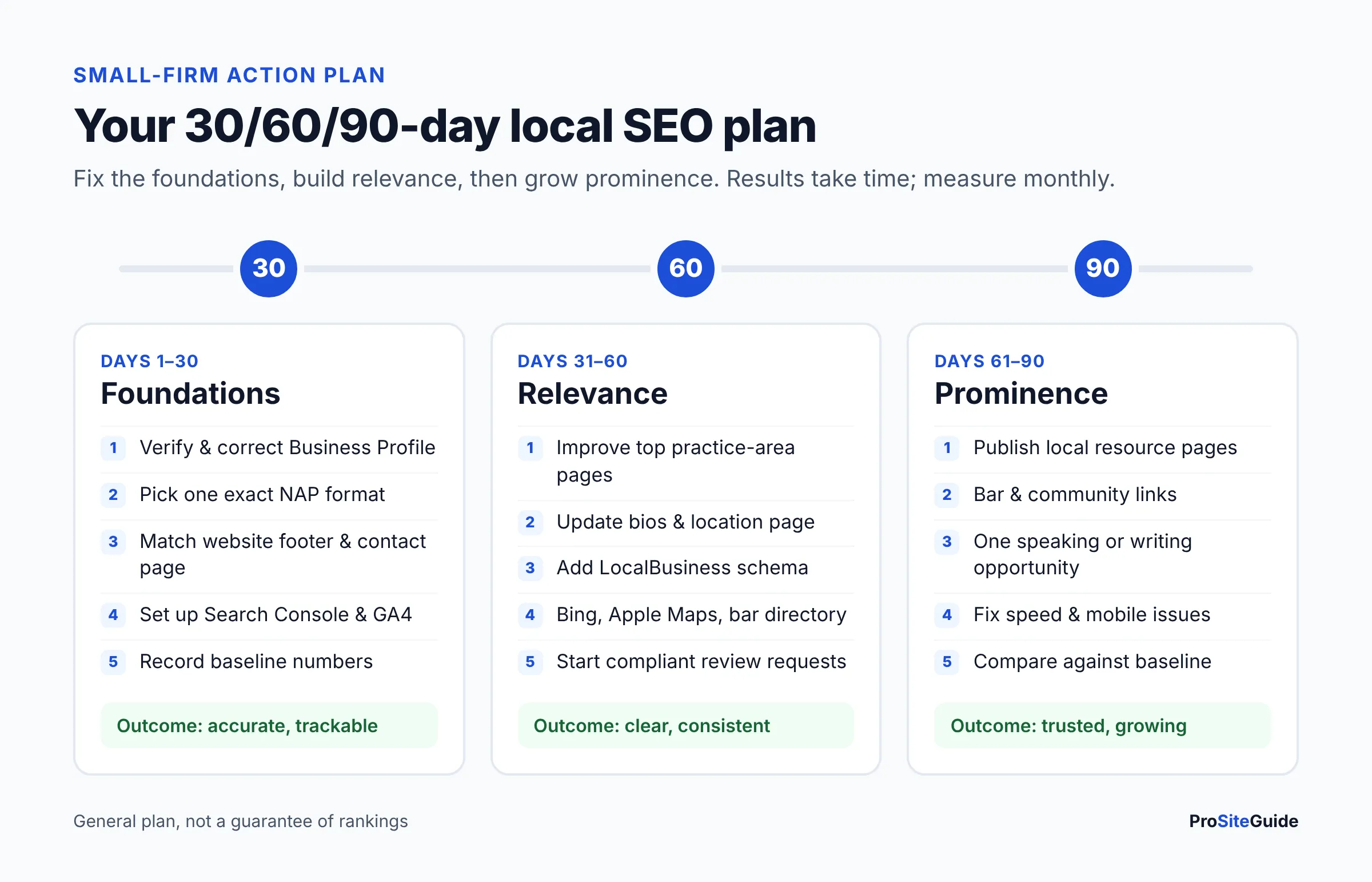
Days 1–30: Fix the foundations
- Claim or verify your Google Business Profile and correct name, address, phone, hours and primary category.
- Decide your exact NAP format and update your website footer and contact page to match.
- Set up Google Search Console and Google Analytics, and add a UTM-tagged link to your profile.
- List every practice area you want clients for and check whether each has its own page.
- Record your starting numbers: profile calls, website clicks, form leads, Search Console clicks.
Days 31–60: Build relevance
- Write or improve your top two or three practice-area pages.
- Update attorney bios and the contact or location page; add structured data.
- Claim Bing Places and Apple Maps listings; update your bar directory record and key legal directories.
- Find and fix duplicate or outdated listings.
- Start a consistent, compliant review request at the close of each matter.
Days 61–90: Grow prominence
- Publish one or two genuinely local resource pages.
- Make sure your bar association, chamber and community memberships link to your site.
- Look for one speaking, writing or community opportunity that could earn a natural mention.
- Check speed and mobile usability; fix the worst issues.
- Compare day-90 numbers with your baseline and choose next quarter’s priorities.
The complete local SEO checklist for attorneys
Use this table as your audit. For a broader site review beyond local search, use our free law firm website checklist.
| Area | Task | Factor it supports | How often |
|---|---|---|---|
| Business Profile | Verified, real-world name, staffed address, correct primary category | Relevance, prominence | Once, then check quarterly |
| Business Profile | Hours, holiday hours, photos of the real office kept current | Relevance | Monthly |
| Website | One dedicated page per practice area | Relevance | Once, review yearly |
| Website | NAP in footer and contact page matching the profile | Prominence (trust) | After any change |
| Website | Location pages only for staffed offices; no near-duplicate city pages | Relevance; avoids spam issues | Once, audit yearly |
| Website | LocalBusiness structured data with name, address, phone, hours | Relevance (clarity) | After any change |
| Citations | Bing Places, Apple Maps, state bar directory, key legal directories | Prominence | Quarterly check |
| Citations | Duplicate and outdated listings removed or corrected | Prominence | After moves or changes |
| Reviews | Same request to every client; no incentives or gating | Prominence | Ongoing |
| Reviews | Replies that don’t confirm representation or reveal details | Prominence; ethics | Weekly |
| Links | Bar, chamber, community and referral partner links | Prominence | Quarterly |
| Content | Local resource pages based on real client questions | Relevance, prominence | Monthly or quarterly |
| Technical | Fast mobile pages, HTTPS, sitemap, tap-to-call, working forms | Supports all | Monthly test |
| Measurement | Profile calls, website clicks, form leads, Search Console clicks | Tracks results | Monthly |
FAQ
How long does local SEO take for a law firm?
There’s no fixed timeline. Google’s SEO Starter Guide says changes take time to be reflected and suggests waiting a few weeks before judging an individual change. Profile fixes can show up sooner; reviews, links and content build over months. Anyone quoting a guaranteed date is guessing.
How do I rank in Google Maps as a law firm?
Google says Maps and local results depend mainly on relevance, distance and prominence. Verify a compliant Business Profile, choose the right primary category, link it to a strong website, keep your NAP consistent, and earn genuine reviews and local links. You can’t pay Google for a better local ranking.
Can I rank in a city where I don’t have an office?
In the map pack, it’s hard, because distance from the searcher is one of the three factors and virtual offices aren’t eligible for a profile. In regular results, a genuinely useful page about serving that area can rank. Just don’t create near-identical city pages, which Google treats as doorway abuse.
Do legal directories still help local SEO?
Accurate listings on reputable directories help confirm your firm’s details and can send clients directly. Their value varies by practice area and city, so check which directories appear when you search for your own services, and track calls from any paid listing.
Is local SEO different from regular SEO for lawyers?
Local SEO focuses on searches tied to a place, including the map pack, so it adds your Business Profile, citations and reviews to the usual website work. For most small firms, nearly all valuable searches are local, so the two overlap heavily.
Should each lawyer at the firm have a Business Profile?
Google’s guidelines treat lawyers as individual practitioners, and the right setup depends on your firm’s size and branding. Our Google Business Profile guide explains the options. Support staff should not have their own profiles.
How much does local SEO cost for a small firm?
The core tools are free: Google Business Profile, Bing Places, Search Console and Google Analytics. Costs come from time, content writing, website work and any paid directory listings or agency help, and those vary widely. Doing the 90-day plan yourself first shows you what’s worth paying for.
Next steps
Start with the 30-day foundations: verify your profile, fix your NAP, and set up measurement. Then work through the deeper guides in this cluster as you reach each step. If you’re new to the site, our Start Here page shows where local SEO fits alongside your domain, hosting and website decisions. Local SEO for lawyers rewards steady, honest work: accurate information, genuinely useful pages and a reputation you earn.
Want this handled for you? ProSiteGuide builds and maintains fast, secure WordPress sites for law firms. Book a free consultation.
Sources
- Google Business Profile Help: Tips to improve your local ranking on Google
- Google Business Profile Help: Guidelines for representing your business on Google
- Maps User Generated Content Policy: Prohibited and restricted content
- Google Search Central: Spam policies for Google web search
- Google Search Central: SEO Starter Guide
- Google Search Central: Local business (LocalBusiness) structured data
- Google Business Profile Help: Understand your Business Profile performance and insights
- Search Console Help: Performance report (Search results)
- Bing Search Blog: Introducing the new Bing Places for Business (October 2025)
- Apple Business
- Minnesota Rules of Professional Conduct, Rule 7.2