Quick answer: For most small firms, the best legal directories for lawyers are the ones that are free to claim and that match how clients actually search: your Google Business Profile, your state or local bar directory, and a claimed free profile on Avvo, Justia, FindLaw/Lawyers.com or Martindale-Hubbell. Paid upgrades are optional. Buy one only if you can measure calls and signed matters against the fee, and only after your name, address and phone number match everywhere.
Key takeaways
- Claim and complete free profiles first. A consistent listing costs time, not money.
- Most directories do not publish prices for paid tiers (as of November 2026). Expect to talk to sales.
- Name, address and phone (NAP) must match across your website, Google and every directory.
- Paying for a directory is advertising or lead generation, so check your state bar rules on both.
- Judge each paid listing by tracked calls and signed matters, not by impressions.
What are legal directories, and do they still matter?
A legal directory is a website that lists lawyers by location and practice area so the public can compare them. They matter in two ways. Some send people to you directly. Others act as independent mentions of your firm on the web, which help confirm that your details are real and consistent. Google says local results are ranked mainly by relevance, distance and prominence, and that prominence includes signals such as links and reviews (see Google’s local ranking explanation). Directories can contribute to that picture, but Google also states there is no way to pay for a better local ranking.
This article covers directories. For the rest of the checklist, see our hub, local SEO for lawyers.
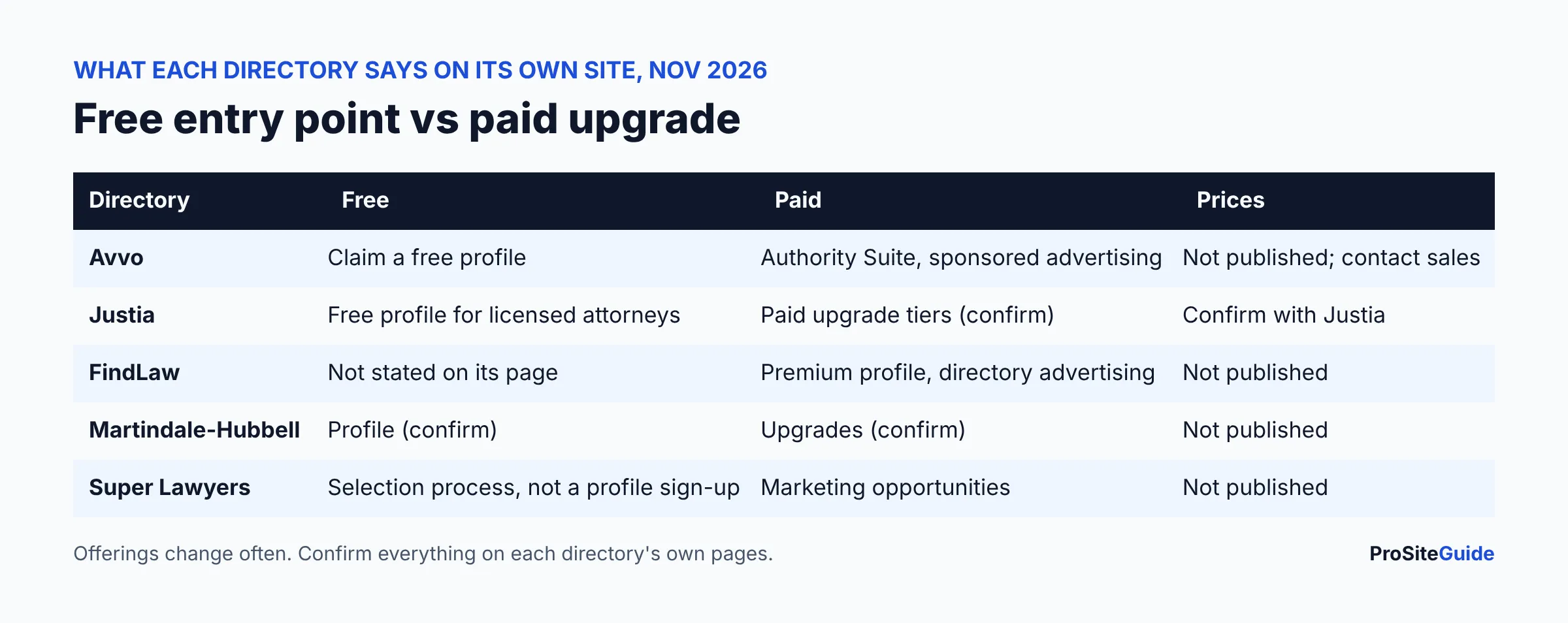
Which legal directories are worth it? A side-by-side look
The table summarizes what each directory says on its own site. We did not test any of these, and we give no traffic or lead figures because none are published. This comparison is based on official pages and may be out of date, so confirm details with each provider. Last checked: 17 November 2026.
| Directory | Free option | Paid options (per official site) | Pricing |
|---|---|---|---|
| Avvo | Claim a free profile | Authority Suite (extends your verified profile across the Martindale-Avvo network) and sponsored advertising spots | Not published; contact sales |
| Justia | Free profile for licensed attorneys (claim and verify) | Paid upgrade tiers exist; confirm current names and prices with Justia | Confirm with Justia |
| FindLaw / Lawyers.com | Not stated on the page we could open | Premium profile and directory advertising | Not published |
| Martindale-Hubbell | Profile on martindale.com (confirm on site) | Profile upgrades; Peer Review Ratings are a separate process | Not published |
| Super Lawyers | Selection is by its own process, not a sign-up | “Marketing opportunities” are listed; details not public | Not published |
| State/local bar directory | Usually included with membership | Varies, often none | Check your bar |
| Google Business Profile | Free | Ads are separate products | Free to claim |
Avvo vs Justia: which should a small firm start with?
Start with both free profiles if you can keep them accurate. Avvo describes its profile as free to claim and describes the Avvo Rating as a 1 to 10 rating; its paid products are Authority Suite and sponsored advertising, with no published prices (Avvo for Lawyers). Justia offers free profiles to licensed attorneys that you claim and verify, with paid upgrades sold separately. If budget is tight, spend nothing on either until you have tracking in place. The real “avvo vs justia” decision is about price and terms, and both require a conversation or a current pricing page.
FindLaw and Lawyers.com
FindLaw’s lawyer page directs lawyers to a premium profile and lawyer marketing solutions, and does not publish pricing (FindLaw for lawyers). Treat it as a paid product and ask for terms in writing, including contract length and cancellation.
Martindale-Hubbell and Super Lawyers
These are as much about reputation as exposure. Martindale-Hubbell runs peer review ratings, where lawyers rate other lawyers; clients do not take part in that peer process. Super Lawyers describes a “patented multiphase selection process” that is “peer influenced and research driven” and selects the “top 5% of attorneys” (Super Lawyers). Its homepage does not state whether a fee applies to selection and gives no marketing prices. Before you advertise a rating, read Rule 7.1 below.
State and local bar association directories
Your state bar’s lawyer search and any county or specialty bar directory are often free with membership. They are also a trusted, official-looking source for your name and contact details, so keep them current. Many bars also run lawyer referral services. Ask your bar how its program works and what it costs.
Google Business Profile
This is the most important free listing for local searches. It has its own guide: Google Business Profile for law firms. If you also want to understand paid placement on Google, see Google Local Services Ads for lawyers.
How do I claim and complete a legal directory listing?
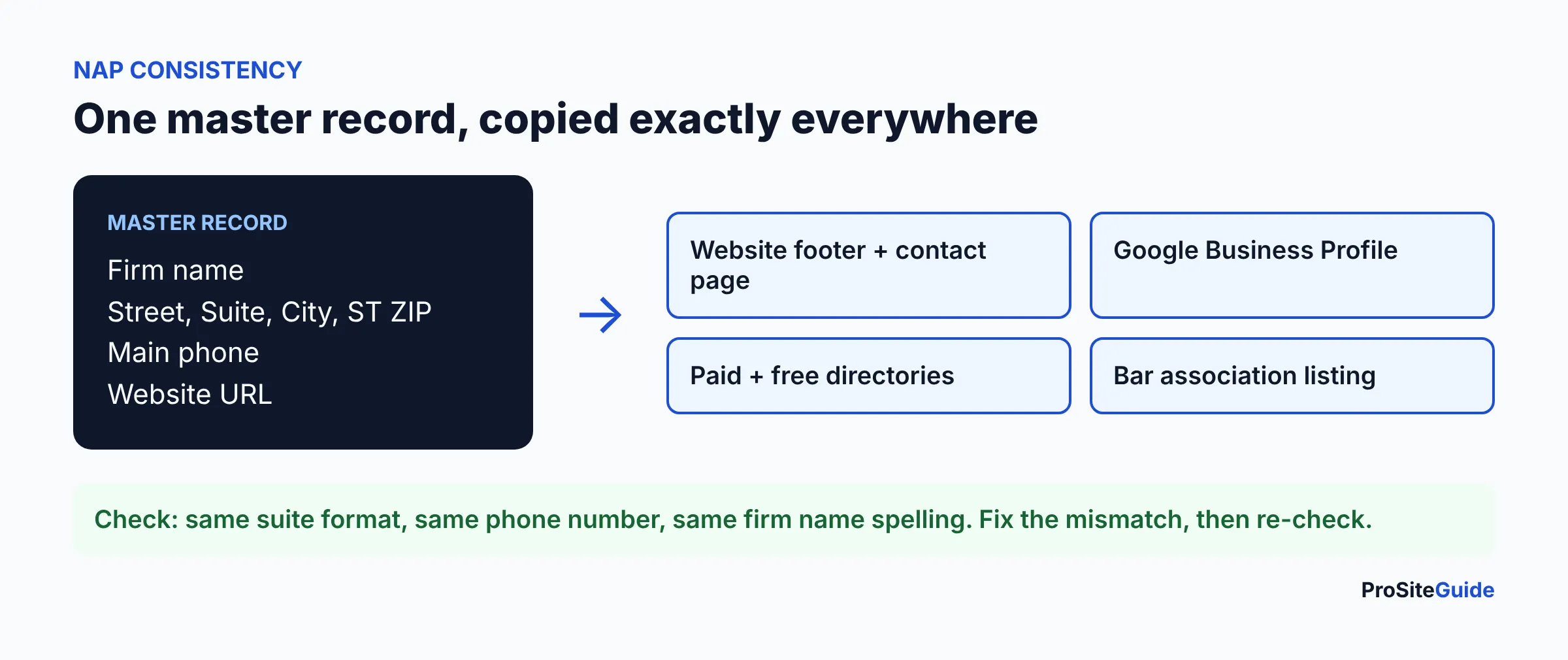
- Write one master record: exact firm name, street address with suite, main phone, website, and a one-paragraph firm description.
- Search the directory for your name. If a profile exists, use its “claim” option and verify your identity; if not, create one.
- Fill every field: practice areas, bar admissions, education, languages, photo, website link and office hours.
- Reuse your attorney bio text, shortened, so descriptions stay consistent.
- Link back to your own site’s contact page, not just the homepage.
- Remove or merge duplicate profiles. Directories sometimes hold old firm names or former addresses.
- Save the login in a password manager and note the renewal date.
What is NAP consistency, and why does it matter for local SEO and AI answers?
NAP stands for name, address and phone number. Consistency means writing them the same way everywhere. Google’s own guidance says to use the name customers know from your signage and stationery, an accurate address, a local number you control, and one profile per location (Google Business Profile content guidelines). When your details differ across sites, search engines and AI answer engines have conflicting data and may show the wrong phone number or skip you. We cannot quantify the effect, and no one outside Google can promise one, but clean, matching data is a low-cost fix.
- Pick one format for suites and abbreviations (“Suite 200”, not sometimes “Ste. 200”).
- Use one main number; if you use tracking numbers, keep the main number as a secondary phone where the directory allows it.
- If you move or rename, update every listing and your website footer the same week.
- Add the same details to your site using schema markup for law firms so machines can read them.
How should I handle reviews on directories?
Directories such as Avvo and Lawyers.com show client reviews, and Google shows reviews on your profile. Respond politely and briefly. Do not reveal confidential information, even if the client has already posted details, and do not confirm that the person was a client. Do not offer gifts for reviews or write them yourself. Rules on responding and on client confidentiality come from your state bar, so check them. See the review section of our Google Business Profile guide for a practical workflow.
Is paying for a directory listing allowed? What do the ABA Model Rules say?
This is general information, not legal advice, and your state’s rules control. Two ABA Model Rules are the usual starting point. Rule 7.1 prohibits false or misleading communications about a lawyer or the lawyer’s services. That covers how you describe ratings, awards and “top” lists. Rule 7.2 permits advertising in any media but, in general, does not allow giving anything of value to someone for recommending your services, with exceptions such as paying the reasonable cost of advertising and certain qualified lawyer referral services. The ABA publishes the text in its Model Rules of Professional Conduct. We could not open those pages automatically for this article, so read them directly.
The practical question is whether a paid listing is advertising (generally fine) or payment for a recommendation or lead (more regulated, and some states restrict fee-sharing and lead generation). Ask the directory how it describes the product, check your state bar’s advertising rules and any opinions on lead generators, and keep copies of what you agreed to. Some states also require disclaimers or filing for advertisements.
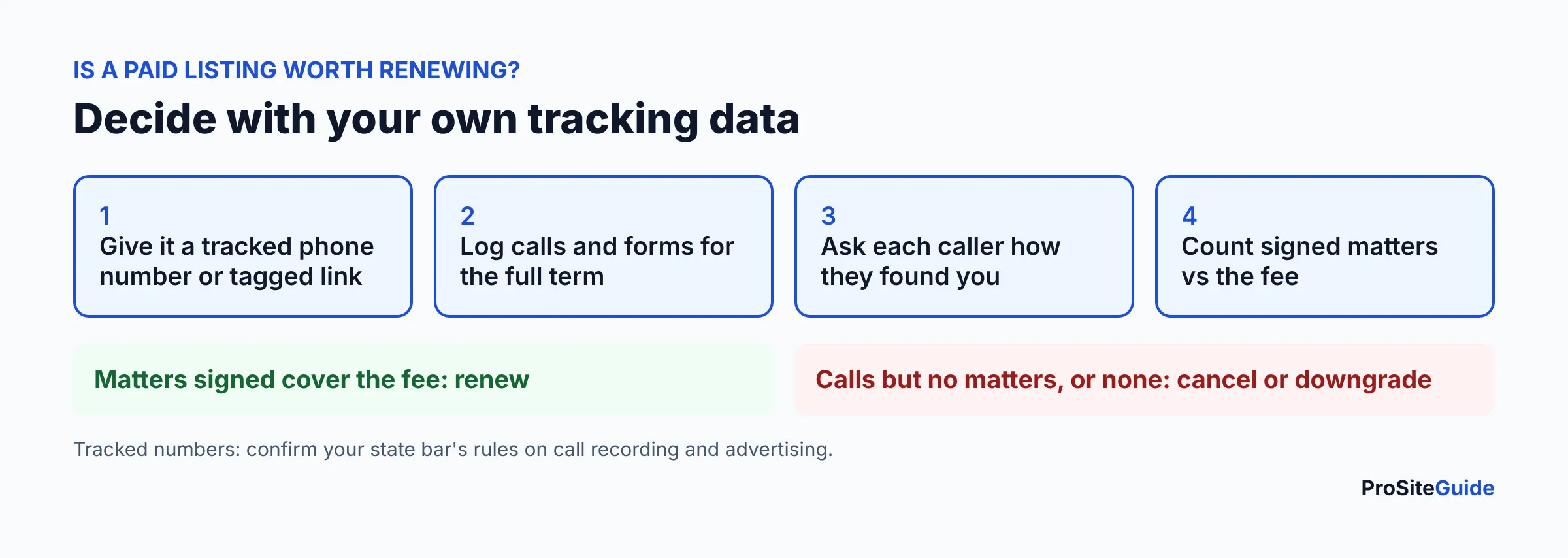
How do I know if a paid directory listing is worth it?
Treat it like any ad: test it, measure it, and renew only if it pays. GA4 and Search Console will show visits from a directory to your website, and a call tracking number or a “how did you hear about us?” intake field covers the rest.
- Ask for the contract term, renewal terms and cancellation rights before you sign.
- Ask what exactly you receive: placement, exclusivity by practice area or county, number of profiles, reporting.
- Set a review date at the end of the term and write down your decision rule in advance, for example “at least one signed matter”.
- Compare the fee with the average fee for the matters you want, using your own numbers.
- Do not rely on directory-supplied “visitor” numbers alone. Count your own calls and forms.
Decision guide: what should a small firm do first?
| Your situation | Suggested path |
|---|---|
| New solo, small budget | Google Business Profile, bar directory, free Avvo and Justia profiles, consistent NAP |
| Established, steady referrals | Add Martindale-Hubbell or Super Lawyers only if peer recognition helps your clients |
| Need more calls now | Ask directories for terms, test one paid listing for one term, and track it; also compare Local Services Ads |
| Multiple offices | One profile per location, each with its own local number |
More guides are at Start Here.
FAQ
Are free legal directory listings worth claiming?
Yes, if you keep them accurate. They cost time, give you a consistent public record, and can only be controlled by you once claimed.
What is the best legal directory for lawyers?
There is no single best. For local reach, Google Business Profile plus your bar directory come first; Avvo, Justia, FindLaw/Lawyers.com and Martindale-Hubbell are the main national options to compare.
Do legal directory backlinks help SEO?
A link from a reputable directory is one more mention of your firm, but Google has not published a link value for directories. Do not buy listings only for links.
How much do paid legal directory profiles cost?
Avvo, FindLaw and Super Lawyers do not publish prices on the pages we reviewed. Check any figures you see on blogs against the directory directly.
Can I pay a directory for leads?
Possibly, but lead generation and fee-sharing are regulated differently from ordinary advertising. Check Rules 7.1 and 7.2 as adopted in your state and your bar’s ethics opinions.
Conclusion: next steps
- Write your master NAP record and audit every listing against it.
- Claim free profiles on Google, your bar directory, Avvo, Justia and, if relevant, Martindale-Hubbell.
- Set up tracking before spending, then test one paid listing for one term.
- Re-check your state bar advertising rules.
Want this handled for you? ProSiteGuide builds and maintains fast, secure WordPress sites for law firms. Book a free consultation.